

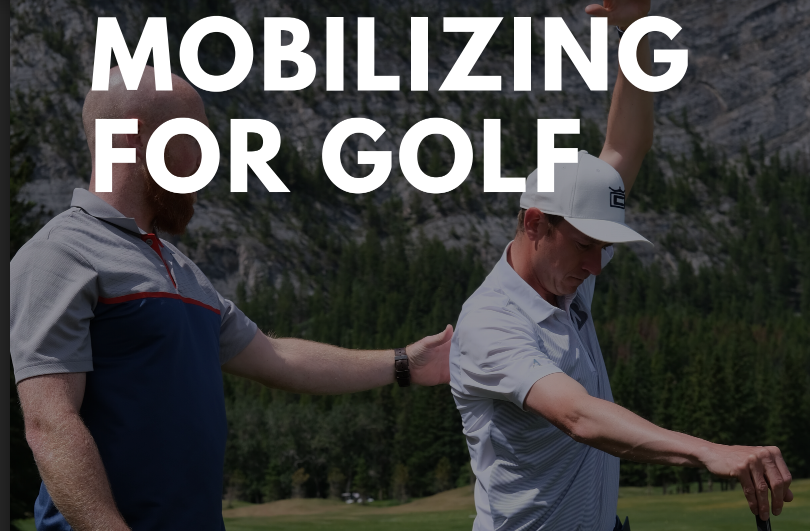
This summer I reached out to a friend in Adam Chivers, Golf Professional at the Fairmont Banff Springs Golf Course, to discuss the importance of mobilising prior to your round. We were discussed the biomechanical demands of the golf swing and how it varies depending on the nature of your shot.
Now we know that the golf swing demands extensive range of motion with a high velocity across the movement, as well as high count of repetitions throughout a round. It is no surprise that a recent review of studies reported that approximately 30% of all golfers have some incident of low back pain after or during golf.
Although an individualised strength and conditioning program can assist in addressing stability and mobility required to keep the risk of injury at bay and improve your current performance. It is still important to ensure that you are preparing your bodies tissues to the force they are likely to experience prior to starting your round.
The tool kit (click the link below) that has been developed ensures that those musculo-skeletal structures are being prepared effectively and efficiently prior to your first swing.
Think of it as you very own golf prep tool kit designed to allow for the appropriate preparation prior to a session on the driving range or a round on the links. It is set out so that it can be performed on range or at the first tee and doesn’t require any additional equipment then a set of clubs.
Mobilising for Golf: warm-up & mobility tools for a round of golf
Be sure to take your time moving through the mobility exercises, you may feel some discomfort as you move through certain movements due to tension or restrictions in mobility. Very important note: you should not be moving into areas of pain and proceed mindfully.
If you have any questions or want a personalised strength & conditioning program do not hesitate to reach out to intrepidperformancetraining@gmail.com.
