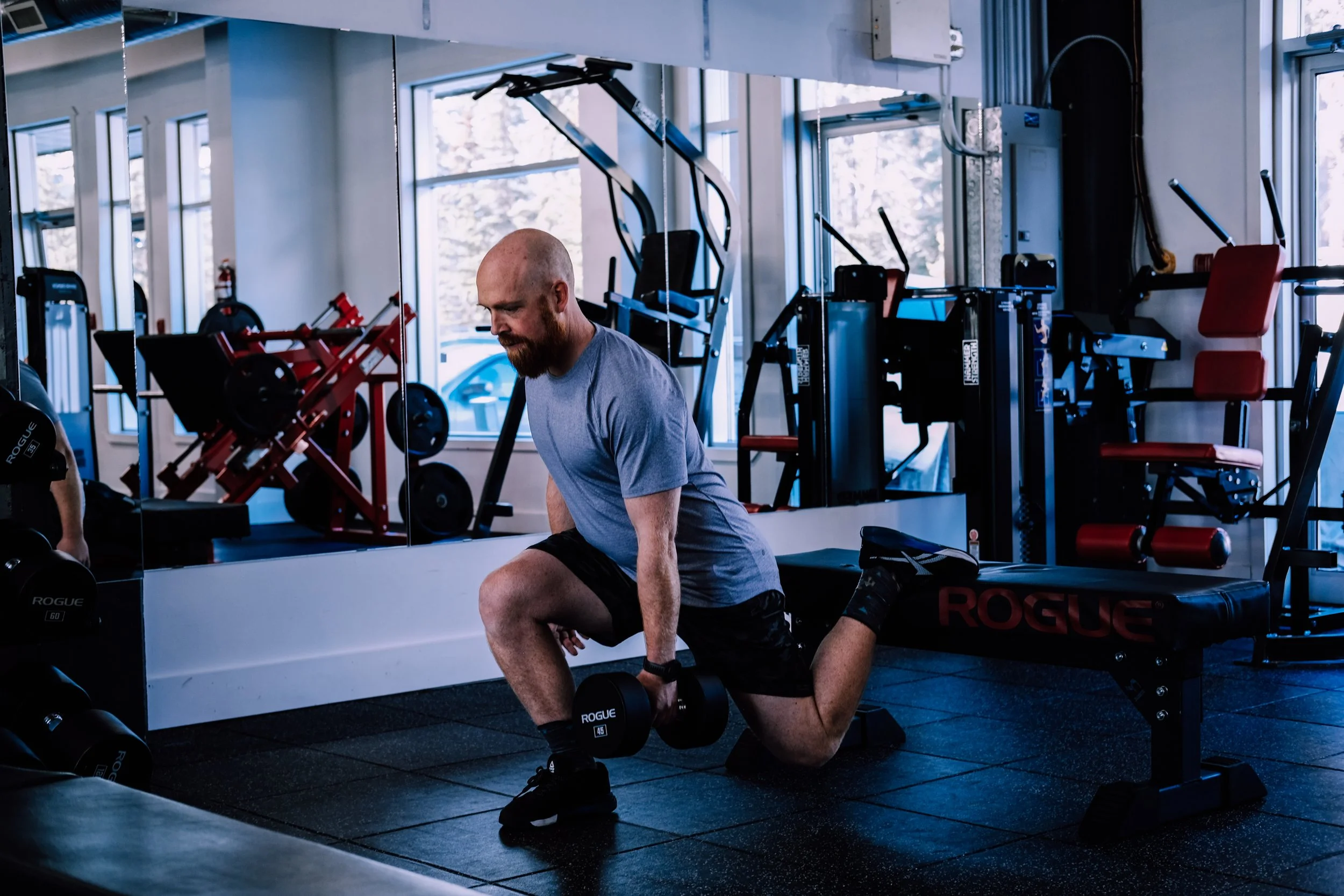
Exercises are merely movements. You shouldn’t be married to the thought that an exercise can only be performed one way and is only used to train one outcome.
The intent of an exercise governs this. The outcome of your intentions in exercise execution is governed by physics (load), biomechanics (joint angles and load profile) and anatomy (soft tissue structures) to perform the movement.
Lets looks at the deadlift which traditionally is performed with a greater focus on the hips and posterior chain. However this can be adapted. Unless you are working towards strength and power sports the traditional deadlift is unlikely to be as beneficial to your outdoor endeavors or sport performance.
Lets look at a B-Stance Deadlift
In the first video a client is performing a B-Stance Trap Bar Deadlift. As you can see her front shin remains vertical which has placed more emphasis on being hip dominant and best replicates the early stage (absorption stage) of gait. Hearing the word deadlift automatically has a connotation of being a posterior chain exercise (working muscles on the back side of the body), which it can be and predominantly is.
HOWEVER this wasn’t the INTENTION for this remote client.
In the second video we see her shin angle decrease and her knee travels forwards placing a greater load into her forefoot and allowing for more of a squat like movement, rather than a hinge movement. Our intent here was to work through a strength block with the goal of improving force production in the propulsion phase of her running/ski stride.
Exercise selection should be governed by movement and not solely by muscles or general conceptions.
TRAIN SMART. WORK HARD.
